Introduction
When students plan their study abroad journey, one of the first questions they ask is: “What are my post-study work rights?” It’s an important question—but relying only on post-study work (PSW) visas like the UK’s Graduate Route or Australia’s Temporary Graduate Visa to secure your future is a risky move.
Why? Because post-study work is a temporary bridge, not a permanent destination. If your long-term goal is permanent residency (PR), you need to think beyond a short-term work visa and consider how your course, location, skills, and career plan align with PR pathways.
To make this clearer, let’s look at three real-life-inspired case profiles.
3 Case Profiles: Graduate Route vs PR Outcomes
Case 1: UK Graduate Route Success, But No PR
- Course chosen: MSc in Business & Management, London
- Post-study visa outcome: 2-year Graduate Route visa
- Job outcome: Marketing assistant in a mid-sized firm
- Challenge: The Graduate Route does not lead directly to PR. After 2 years, Riya needed employer sponsorship under the Skilled Worker visa. Unfortunately, her employer wasn’t licensed to sponsor, leaving her uncertain about staying in the UK long-term.
👉 Lesson: A Graduate Route visa is great for work experience, but unless you secure a Skilled Worker sponsor, it won’t convert into PR.
Case 2: Australia PR Advantage
- Course chosen: Master’s in Civil Engineering, Sydney
- Post-study visa outcome: 3-year Temporary Graduate Visa (485)
- Job outcome: Structural engineer in a regional city
- PR pathway: Civil engineers are on Australia’s Skilled Occupation List. Working regionally gave him extra PR points, and within 3 years, he secured a Skilled Independent Visa (PR).
👉 Lesson: Choosing a high-demand occupation aligned with PR needs gave Anil a smoother pathway compared to just depending on a temporary work visa.
Case 3: Canada Study to PR Success
- Course chosen: Bachelor’s in Nursing, Toronto
- Post-study visa outcome: 3-year Post-Graduation Work Permit (PGWP)
- Job outcome: Registered nurse in a hospital
- PR pathway: After gaining 1 year of skilled work experience, she applied through Express Entry – Canadian Experience Class (CEC) and received PR within 18 months.
👉 Lesson: Canada’s PGWP is designed to align closely with PR streams, making it easier for students to transition if their course and career are in demand.
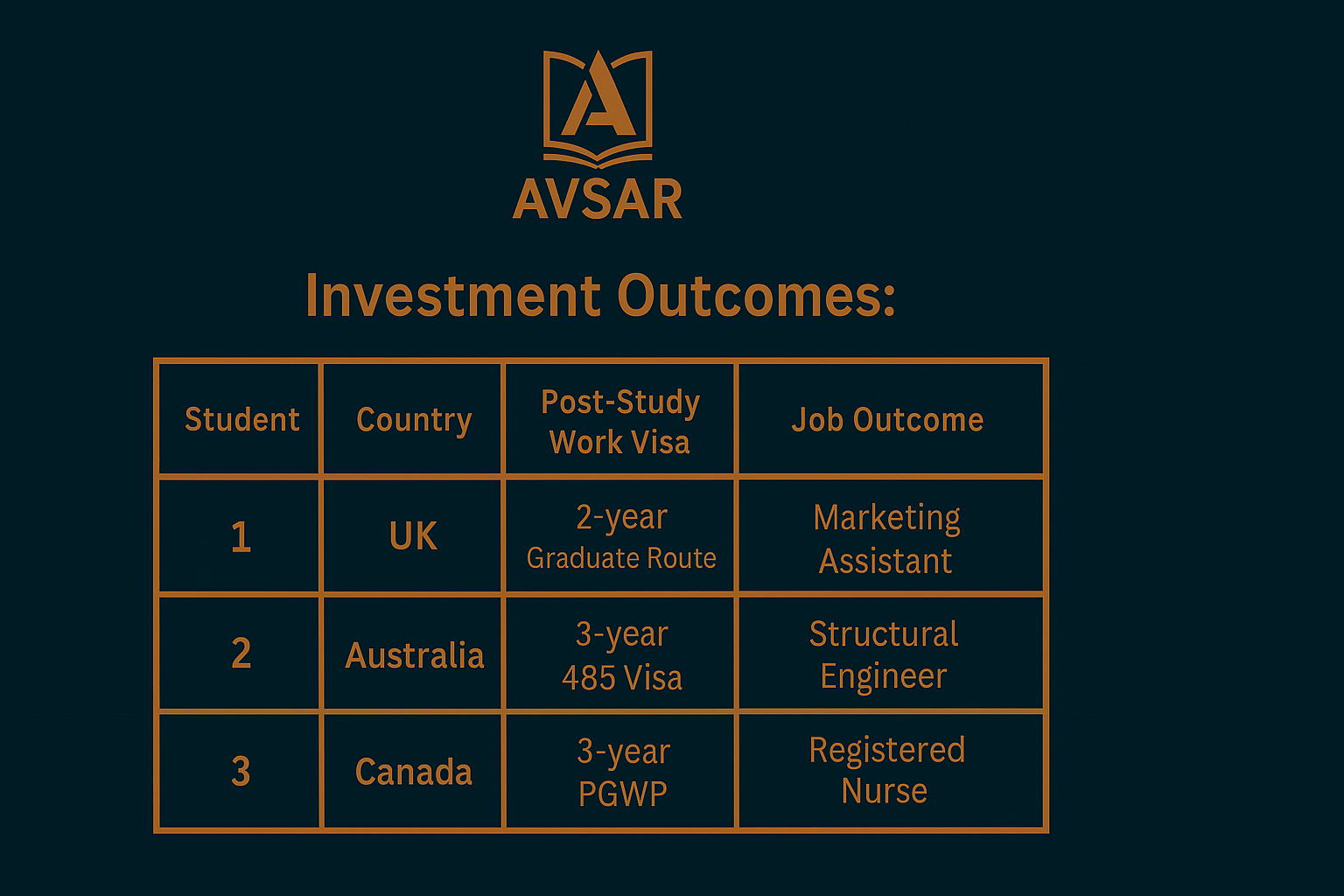
Comparison Table: Course vs Outcome
| Student | Country | Course | Post-Study Work Visa | Job Outcome | PR Pathway | Result |
| 1 | UK | MSc Business & Management | 2-yr Graduate Route | Marketing assistant | No direct PR link | Uncertain |
| 2 | Australia | Master’s in Civil Engineering | 3-yr 485 visa | Structural engineer (regional) | Skilled Migration points | PR secured |
| 3 | Canada | Bachelor’s in Nursing | 3-yr PGWP | Registered nurse | CEC – Express Entry | PR secured |
Why You Shouldn’t Pick a Course Just for Post-Study Work
- Temporary vs Permanent: Post-study work visas expire—PR requires long-term planning.
- Occupation Demand Matters: Countries like Australia and Canada prioritize skills in shortage. Picking a course unrelated to these lists may limit PR chances.
- Location Matters: Studying in regional areas (Australia, Canada) often gives extra PR points.
- Employer Sponsorship Risks: In the UK and US, your PR (or equivalent) often depends on employer sponsorship, which can be uncertain.
- Future Policy Shifts: Immigration rules change often. A course that seems PR-friendly today may not guarantee the same tomorrow.
Smarter Way to Plan Your Studies
✅ Research PR pathways first, then select your course.
✅ Choose in-demand fields (STEM, healthcare, trades, engineering, IT).
✅ Balance passion + PR prospects—don’t just follow trends.
✅ Stay updated on immigration policy changes.
✅ Seek professional guidance before finalizing your study destination.
Final Thoughts
Studying abroad is a life-changing investment—not just in education, but in your future. While post-study work routes like the UK’s Graduate Route or Australia’s Temporary Graduate Visa are valuable stepping stones, they are not permanent solutions.
If PR is part of your long-term dream, think strategically: pick a course that aligns with both your career goals and your destination’s immigration needs. That way, your education isn’t just a degree—it’s the foundation of a sustainable future.